The Move-Out Cleaning Checklist That Gets Your Deposit Back
A security deposit is often a full month's rent — real money you already earned and should get back. Landlords are allowed to deduct for damage beyond normal wear, but not for a dirty oven you could have cleaned. This checklist covers every room and the paper trail that protects you.
Before you touch a sponge: document everything
Cleaning matters, but documentation is what actually protects your deposit. Walk the apartment with your phone and photograph every room from multiple angles — walls, floors, appliances, inside the oven and fridge — in good light.
Then pull out your move-in photos or move-in inspection sheet, if you kept them. Compare. Any damage that was already there when you moved in is not yours to pay for, but only if you can prove it. Make a short written list of pre-existing issues with the dates and photos attached, and keep a copy for yourself. Do this before you clean, because once everything sparkles, "that stain was already there" becomes much harder to prove.
Kitchen: the deposit-killer room
Landlords scrutinize kitchens hardest because grease is obvious and expensive to remediate. Work through this list:
- Oven: clean the interior, the door glass, the racks, and under the bottom drawer. Pull it out from the wall and clean behind it.
- Fridge: empty it, pull it out, clean behind and underneath, wipe every shelf and drawer, and clean the top — a spot almost everyone misses.
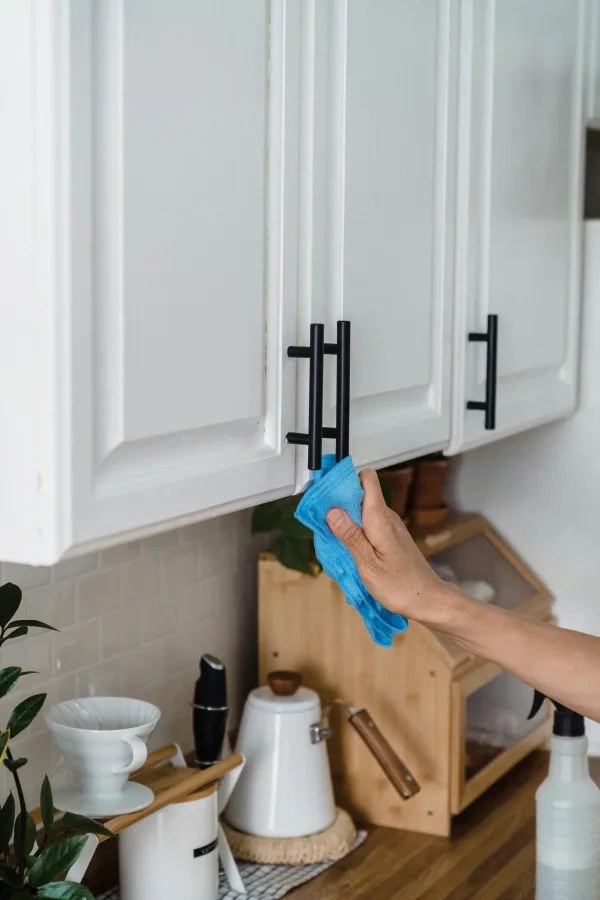
- Cabinets and drawers: wipe inside and out, including the cabinet above the stove, which collects a film of grease.
- Stovetop and drip pans: if the burners have drip pans, pull them out and scrub them. If they are warped or rusted through, replacing them is cheap and landlords notice.
- Sink, faucet, and backsplash: scrub away water spots and any grout or caulk discoloration.
- Range hood filter: if it is greasy, degrease it or note it to the landlord.
Bathroom
Bathrooms get judged on mildew, grime, and fixtures. Cover these:
- Scrub the tub/shower, including the grout lines and the caulk edges — mildew on caulk is one of the most common deductions.
- Clean the toilet inside and out, including behind the base where dust collects.
- Wipe the mirror, light fixtures, and medicine cabinet inside and out.
- Scrub the sink, faucet, and countertop; remove any soap buildup.
- Sweep and mop the floor, getting into the corners and behind the door.
- Replace any burned-out bulbs and clean the exhaust fan cover — a dusty fan reads as neglect.
Every other room
- Walls: wipe down scuffs and marks. Fill small nail holes with spackle, let it dry, and touch up with paint if your lease or landlord expects it. Ask before repainting whole walls — the wrong color is worse than a filled hole.
- Baseboards: wipe them down; dusty baseboards make a clean room look dirty.
- Windows and blinds: clean the glass, wipe the sills and the window tracks (tracks collect shocking amounts of dirt), and dust or wipe the blinds.
- Closets: empty completely, wipe shelves, check the floor.
- Light fixtures and ceiling fans: dust them; replace dead bulbs.
- Floors: vacuum carpets thoroughly (some leases require professional carpet cleaning — check yours), sweep and mop hard floors, and clean any stains you can.
The spots landlords always check
After years of move-out inspections, landlords develop a routine. These are the places they look that renters forget:
- Top of the refrigerator and top of the kitchen cabinets
- Inside the oven and under the burners
- Window tracks and sliding-door tracks
- Drip pans under stove burners
- Behind the toilet and behind the bathroom door
- Inside the dishwasher filter
- Ceiling fan blades and light switch plates
It helps to know what landlords are actually allowed to charge for. Normal wear and tear — small nail holes from hanging pictures, faint scuffs on walls, carpet flattened where furniture sat — is the landlord's cost of doing business, not a deduction from your deposit. Damage is things like large holes in drywall, pet-stained carpet, broken fixtures, or burns and chips in countertops. Cleaning well eliminates the gray area: when the place is spotless, a landlord cannot blame "filth" for wear that was always normal.
Also check your lease for the phrase "broom clean" or a move-out cleaning standard. Some leases require the unit back in the same condition as move-in minus normal wear; a few require professional carpet cleaning with a receipt. If yours requires a receipt, get it done and keep the invoice — it is cheaper than the deduction.
After cleaning: the walkthrough and paper trail
Once the place is clean, photograph everything again — same angles as before. Then:
- Do a final walkthrough, ideally with the landlord present, and note any issues together.
- Return every key, garage remote, mailbox key, and access fob. Get a written receipt showing what you returned and when.
- Give the landlord your forwarding address in writing so the deposit (or an itemized deduction list) can reach you.
- Keep copies of your before and after photos, the receipt, and any correspondence.
If the deductions seem unfair, dispute them in writing, calmly, with your photos attached. And know your state's deposit-return deadline — every state sets its own limit on how long a landlord has to return your deposit or send an itemized list of deductions, and it varies widely, so look up your state's rule rather than guessing. If the deadline passes with no deposit and no itemization, that is usually a strong position for you.
When in doubt, call a licensed professional — some jobs are not worth the risk.