How to Make a Small Kitchen Work Twice as Hard
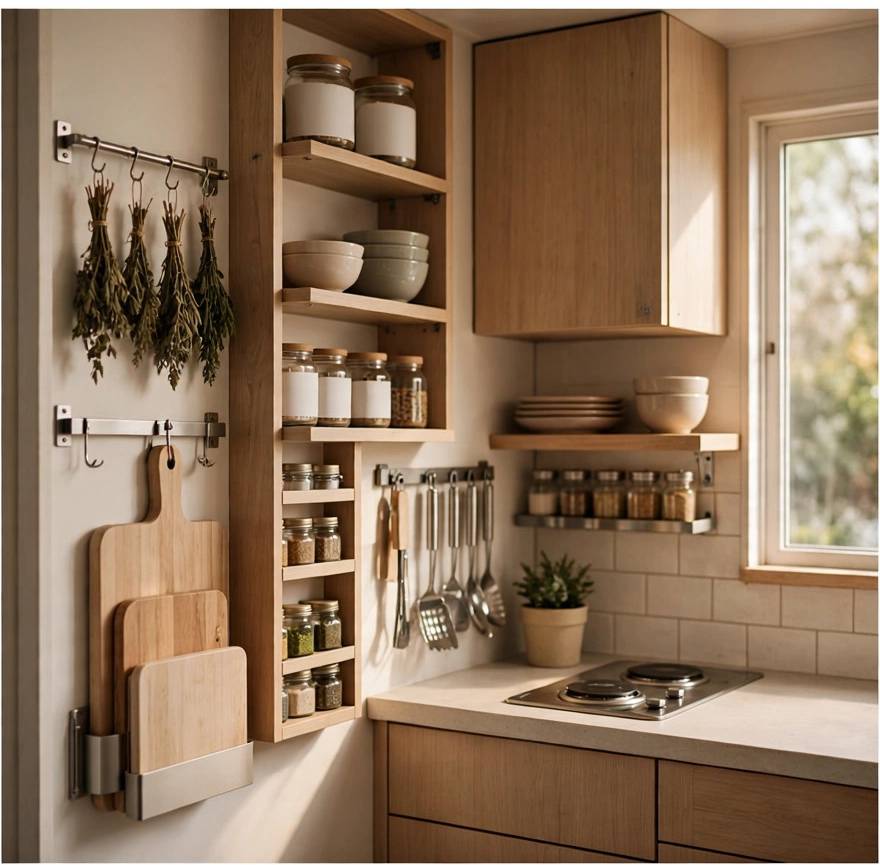
A small kitchen does not need more organizers everywhere. It needs clear work zones, useful vertical storage, and fewer things competing for the same square foot.
Your kitchen is 60 square feet. The counter holds a toaster, a knife block, a paper towel holder, and exactly zero inches of working space. Every meal is a shuffling game where the cutting board goes where the dishes were and the dishes go where the cutting board was.
The problem is not the size. It is that everything in a small kitchen is sitting on the counter by default, because nobody gave it a better home. Fix that, and a tiny kitchen works as well as one twice its size. Here is how, for about $200 total and one weekend.
Go vertical: walls and airspace are free storage
Counters are the scarcest real estate in a small kitchen. Walls are not. An 18-inch magnetic knife strip costs about $15, mounts with two screws, and takes the knife block off the counter permanently. Knives stored on a magnetic strip stay sharper than knives rattling in a drawer, and you can see every blade at a glance.
Shelf risers are the cheapest square-footage multiplier in the kitchen. A $10 wire riser turns one cabinet shelf into two, doubling the usable space for mugs, plates, or spice jars. Under-shelf baskets hook onto existing shelves for another $8 to $12 each and swallow the odd-shaped stuff: packets, lids, the garlic press nobody can find.
If you have 24 inches of open wall, a stainless steel rail with S-hooks runs about $20 and holds utensils, pots, and measuring cups off the counter. A pegboard panel is the budget version at $15 to $25 plus a $5 bag of hooks, and it lets you rearrange the layout whenever your cooking changes. Restaurants hang everything. Small kitchens should steal that idea.
Use the insides of the doors
Cabinet doors have roughly two square feet of unused surface each, and in a small kitchen you might have six of them. Over-the-door racks at $12 to $18 each turn the inside of a cabinet door into a spice rack, a lid organizer, or a cleaning-supply caddy. Under the sink, a tension rod for $8 gives spray bottles a place to hang so they stop falling over every time you reach for the dish soap.
Command hooks inside cabinet doors hold measuring cups and spoons by their hanging holes. A $7 pack of hooks and 10 minutes turns the inside of your most-used cabinet door into a measuring station. The pantry door is the biggest opportunity: a narrow over-the-door pantry organizer costs $25 to $40 and holds cans, boxes, and bottles in space that was doing absolutely nothing.
Reset the pantry with containers that stack
Open bags and half-used boxes are space thieves. A set of stackable airtight containers, about $30 for a 10-piece set, turns a chaotic pantry shelf into a neat grid where every inch is usable and you can see what you actually have. Square containers waste less space than round ones, and uniform sizes stack without the Jenga tower.
A lazy Susan turntable for $12 to $15 rescues the back corners of deep cabinets where jars go to die. Two-tier versions double that effect. And decant the bulky stuff: flour, sugar, rice, and pasta take up 30 percent less room outside their original packaging, and they stay fresher.
Group like with like: baking together, cooking together, snacks together. It sounds obvious. It is not what most pantries look like. When everything has a zone, you stop buying a third jar of cumin because you could not find the other two.
The cutting-board-over-sink trick
In a small kitchen, the sink is not just a sink. It is potential counter space with a drain in it. A cutting board sized to sit across the sink, about $25 to $35 for a bamboo one with a lip, gives you back two square feet of prep space instantly. Use it for chopping, then slide it aside to rinse. Some models have a colander attachment built in, which is a small miracle in 60 square feet.
Same logic applies everywhere: nesting bowls replace the mismatched set, a collapsible colander folds flat, and a dish rack that drains into the sink beats a countertop one that steals a square foot permanently. Every item in a small kitchen has to justify its footprint every single day.
Adopt the one-in-one-out rule
Here is the uncomfortable truth about small kitchens: no organization system survives a surplus of stuff. Before buying a single hook or rack, pull everything out of the cabinets and be honest about the duplicates. Two spatulas? Keep one. Three half-empty bottles of vegetable oil? Finish two. The bread maker you used once in 2023? It lives on top of the cabinets now or it leaves.
Then enforce the rule going forward: every new kitchen item means an old one goes. New mug in, old chipped mug out. New pan in, the warped one out. Small kitchens do not have a storage problem. They have an accumulation problem with a storage symptom.
One more rule while you are at it: if a small appliance has not been used in 90 days, it moves out of the kitchen. The waffle maker can live in a closet. The stand mixer you use every Sunday earns its counter spot. Everything else is decoration with a power cord.
A $200 small-kitchen weekend, itemized
Here is the full project as a shopping list, because vague advice is useless:
- Magnetic knife strip: $15
- Two shelf risers: $20
- Over-the-door pantry organizer: $30
- 10-piece stackable container set: $30
- Pegboard panel with hooks: $25
- Cutting board for over the sink: $30
- Under-shelf baskets (set of 2): $18
- Command hooks and tension rod: $15
- Lazy Susan turntable: $14
Total: roughly $197, give or take what is on sale. Saturday: declutter and enforce one-in-one-out. Sunday: mount, hang, and organize. By Sunday night, you have a kitchen where the counter is clear, everything is visible, and cooking stops feeling like a contact sport.
Small kitchens reward the organized and punish the passive. The square footage is fixed. The storage is not. Go claim your walls.