Grocery Budgeting That Actually Works in 2026
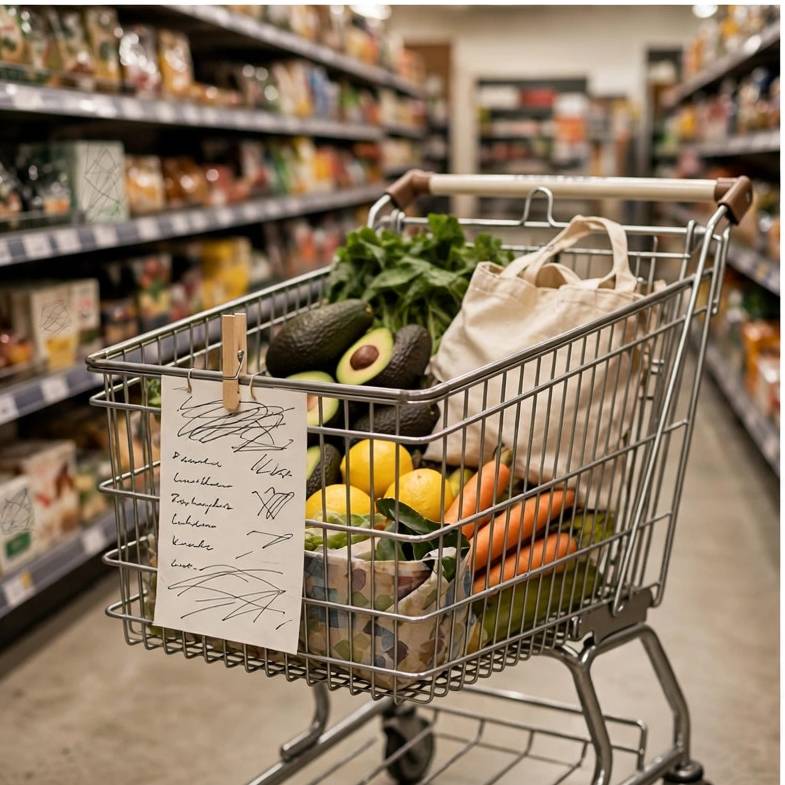
Grocery spending usually leaks through extra trips, convenience add-ons, and food that never becomes a meal. A realistic target and one dependable shopping system fix more than coupon hunting.
The average American household spends over $1,000 a month on food, and a shocking amount of that goes straight into the trash. Not because anyone's wasteful on purpose — because grocery budgeting is treated like a willpower problem when it's actually a systems problem.
"Just follow 50/30/20" is the most useless advice in personal finance, and it fails hardest at the grocery store. Fifty percent of what? Your "needs" in a high-cost city look nothing like someone's in a low-cost town. Forget the ratios. Here's what actually works in 2026: a number, a list, and a routine.
Step 1: Find your real number
Not a target. Not an aspiration. Your actual spending. Pull three months of bank and card statements and total what you spent at grocery stores. Not restaurants — groceries. That number is your starting point, and it will probably annoy you.
Say it's $850 a month for a family of four. Now set your budget at 15–20% below that: $680–$720. Why not slash it in half? Because a budget you abandon in week two isn't a budget. It's a guilt trip. Shave 15–20%, stabilize, then shave again next quarter. Sustainable beats heroic.
Reference points for sanity-checking: in 2026, a realistic monthly grocery budget runs roughly $250–$350 per adult and $150–$250 per child, varying wildly by region. A family of four landing at $700–$900 total is doing fine. Below $600 and you're probably under-eating or under-counting. Above $1,100 and there's fat to cut — unless you're in a genuinely expensive metro.
Step 2: The list is law
Every successful grocery budget in history has one thing in common: a written list, made before entering the store, followed without exception. Impulse buys add 15–25% to the average cart. On an $800 monthly budget, that's $120–$200 a month — $1,440–$2,400 a year — spent on things you didn't plan to buy.
The system that works:
- Plan five dinners, not seven. Two nights a week are leftovers, pantry meals, or eating out. Planning seven perfect dinners is how meal plans die.
- Build the list from the plan. Ingredients for those five meals, plus breakfast and lunch staples. Nothing else.
- Shop once a week. Every extra trip is another round of impulse buying. One trip, one list, done.
- Eat before you go. Hungry shoppers spend measurably more. A $2 snack before the store saves $20 in the store.
Step 3: The 80/20 of grocery savings
You don't need coupon apps, twelve store loyalty programs, and a spreadsheet. Four moves capture most of the savings:
- Buy the store brand for staples. Flour, sugar, milk, eggs, canned beans, frozen vegetables, pasta — the store brand is usually 20–40% cheaper and functionally identical. Nobody at your dinner table can tell the difference in a casserole.
- Anchor meals on cheap proteins. Eggs (~$0.20 each), dried beans and lentils (pennies per serving), chicken thighs instead of breasts, and one or two meatless nights a week. A family of four can cut $80–$120 a month here without anyone feeling deprived.
- Shop the store's loss leaders. The front-page deals in the weekly flyer are priced to get you in the door — they're genuinely cheap. Build one or two meals a week around whatever's on deep discount.
- Freeze like you mean it. Bread, meat bought on sale, cooked rice, soup, berries — the freezer is a time machine that turns "use it or lose it" into "use it whenever." Food waste is the silent budget killer; freezing is the fix.
Step 4: Track it weekly, not monthly
Monthly budgets fail because you discover the damage on the 28th, when it's too late. Weekly tracking works because you catch it on the 7th.
Divide your monthly budget by four (roughly). A $720 monthly budget is $180 a week. After each shopping trip, subtract from the week's envelope — a notes app, a whiteboard on the fridge, whatever you'll actually look at. If Tuesday's trip cost $150, you have $30 left for the week. That number, visible and current, is what changes behavior. A monthly total is a postmortem. A weekly number is a steering wheel.
Step 5: Separate the categories that aren't groceries
Here's where most budgets quietly break: the grocery run includes toilet paper, cleaning supplies, diapers, pet food, and shampoo. Those aren't groceries. They're household expenses wearing a grocery costume, and they make your food budget look broken when it isn't.
Two options: split them at the register (most stores will do separate transactions) or budget them separately as a household line item. A family of four typically spends $80–$150 a month on non-food household goods. Pull that out of the grocery number and suddenly your food budget looks achievable — because it is.
The two traps that wreck grocery budgets
Trap one: the warehouse club "savings." Buying in bulk saves money only if you use it all before it expires and didn't buy things you wouldn't have bought otherwise. The $200 Costco run that includes a kayak and three pounds of gummy bears is not saving you money. Bulk-buy the five staples you always use. Skip the rest.
Trap two: delivery fees as a lifestyle. Grocery delivery is convenient and expensive — service fees, tips, and marked-up prices can add 15–30% to the same cart. On a $700 budget, that's $105–$210 a month for convenience. If delivery keeps you from impulse-buying in-store, it might break even. If not, it's a luxury line item, not a grocery line item.
Putting it together: the $720 month
Let's make it concrete. Family of four, $720 monthly grocery budget, groceries only (household goods tracked separately):
- Weekly food budget: $180
- Five planned dinners anchored on cheap proteins and sale items: ~$70/week
- Breakfast and lunch staples (eggs, oats, bread, fruit, yogurt): ~$55/week
- Snacks, dairy, produce top-ups: ~$35/week
- Buffer for price swings: ~$20/week
First month, you'll probably land at $780–$800. That's fine — you're calibrating. Month two, the list habit kicks in and the impulse number drops. Month three, you're at $720 without thinking about it. The budget didn't get easier. You got better at it.
Grocery budgeting isn't about eating rice and sadness. It's about deciding where the money goes before the store decides for you. A number, a list, a routine. That's the whole system — and it works in 2026 the same way it worked in 1996, because human behavior hasn't changed, only the prices have.