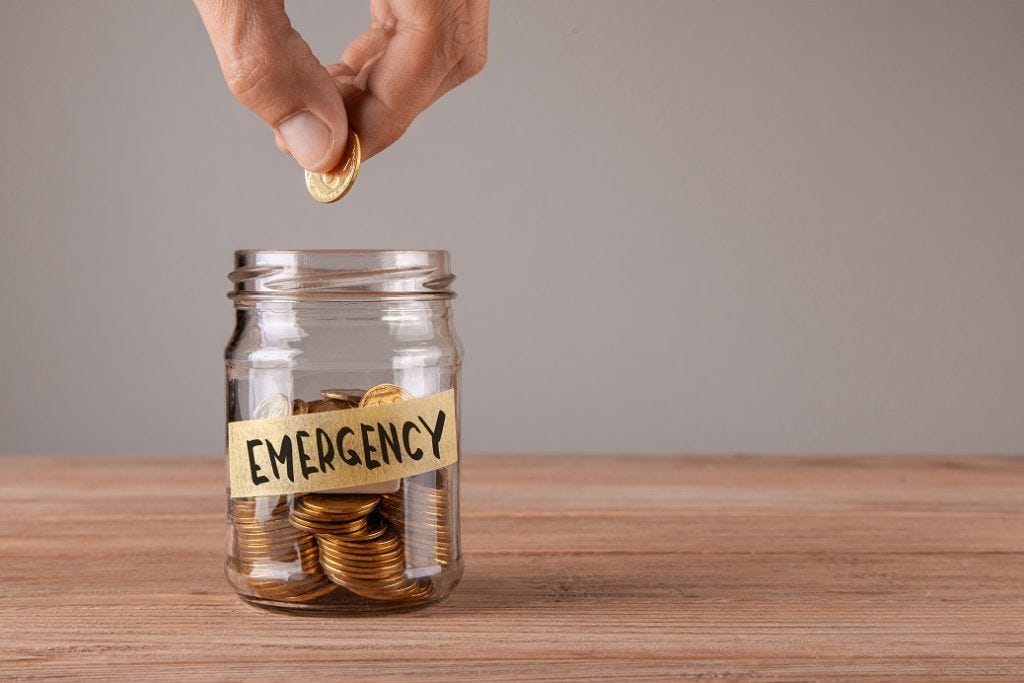
Emergency Fund or Pay Off Debt First? The Honest Answer

Saving cash while paying interest can feel backward, but having no buffer sends the next surprise straight back to a card. The useful answer is a sequence, not an all-or-nothing rule.
This is the question that starts fights in comment sections. "Pay off debt first!" "No — you need an emergency fund!" Both sides talk like it's obvious. Both sides are wrong in the same way: they're answering a different question than the one you're actually asking.
Your actual question is: I have $300 extra a month. Where does it go? The honest answer isn't one answer. It's three phases, in order, and the order matters more than the amounts.
Phase 1: Build a small starter fund first
Before you attack a single dollar of debt, save $1,000 in a separate savings account. Not $5,000. Not three months of expenses. One thousand dollars.
Why? Because life doesn't pause while you pay off debt. The car needs a $600 repair. The kid needs stitches. The water heater leaks. Without that $1,000 buffer, every surprise goes on the credit card — and you're back at square one with more debt than you started with. The starter fund isn't savings in the traditional sense. It's debt repellent.
If you can put $300 a month toward it, you're done in a little over three months. During those three months, pay only minimums on your debt. That's it. Minimums plus $300 to the fund until it hits $1,000.
Phase 2: Attack the high-interest debt
Now the math takes over. List every debt with its balance and interest rate. Then kill them in order of highest rate first — the avalanche method. Not the smallest balance first. The highest rate.
Why avalanche instead of the popular "snowball" method (smallest balance first)? Math. On a $5,000 balance at 24% APR, you're paying about $100 a month in interest alone. On a $2,000 balance at 12%, it's about $20. Every dollar thrown at the 24% debt saves you more than a dollar thrown at the 12% debt. The snowball feels better. The avalanche costs less. Feelings don't pay interest; math does.
Let's run it. Say you owe:
- Credit card: $6,000 at 24% APR
- Personal loan: $3,500 at 12% APR
- Car loan: $9,000 at 7% APR
Minimums total about $340 a month. You have $640 a month total to work with ($340 minimums + $300 extra). Put the $300 extra on the credit card. Every month, that card shrinks fastest, and when it's gone, that whole payment rolls to the personal loan, then the car loan.
At that pace, the credit card is dead in roughly 16 months. Without the extra $300, it would take over three years and cost about $2,500 more in interest. That $300 a month is worth $2,500 in avoided interest on this one card alone. Let that sink in.
Phase 3: Build the real emergency fund
Once the high-interest debt (anything above roughly 8–10%) is gone, redirect that whole debt-payment amount into your emergency fund. This is the part everyone skips, and it's the part that keeps you out of debt permanently.
The target: three to six months of essential expenses — housing, utilities, food, transport, insurance, minimum debt payments. Not three to six months of your current lifestyle. Essentials. For a household spending $3,000 a month on essentials, that's $9,000–$18,000.
That's a lot. It takes time. At $640 a month, $12,000 takes about 19 months. That's fine. The starter fund protected you during the debt phase. The full fund protects you from ever needing the debt phase again. Speed matters less than the fact that it grows every single month without fail.
The exceptions, honestly stated
Low-interest debt can wait. A 4% car loan or a federal student loan at 5%? Those can ride while you build the emergency fund. The interest is cheap, and the cash buffer protects against bigger risks. There's no prize for being debt-free if one emergency sends you right back into high-interest debt.
If your income is unstable, flip the order. Freelancers, gig workers, commission-based earners — you should build a bigger cash buffer before attacking debt aggressively, because your "emergency" probability is higher. Two to three months of expenses before the debt attack is reasonable. The $1,000 starter rule assumes a steady paycheck.
Windfalls go to the current phase. Tax refund, bonus, sold the old couch — it doesn't get "spent a little, saved a little." It goes to wherever you are in the sequence: starter fund if it's not at $1,000 yet, highest-rate debt during Phase 2, the full fund during Phase 3. Windfalls are how people finish the whole plan a year early instead of drifting.
Retirement match is the one thing that runs parallel. If your employer matches 401(k) contributions, contribute enough to get the full match even during Phase 2. That's an instant 50–100% return. No debt payoff beats that. Everything beyond the match waits until the debt is gone.
Why this order works
The sequence — starter fund, then high-interest debt, then full fund — exists because each phase protects the next. The starter fund keeps new debt from forming while you pay down old debt. The debt payoff frees up cash flow for the full fund. The full fund makes the whole system permanent.
Skip the starter fund and every emergency becomes new credit card debt. Skip the debt attack and you bleed interest for years. Skip the full fund and one job loss restarts the entire cycle. The order isn't a suggestion. It's the load-bearing wall.
So: $1,000 first, avalanche the expensive debt, then build the real cushion. Three phases, one direction, no shortcuts. It's not the fastest plan or the most exciting plan. It's the plan that actually holds.