Sinking Funds: The Savings Trick Nobody Talks About

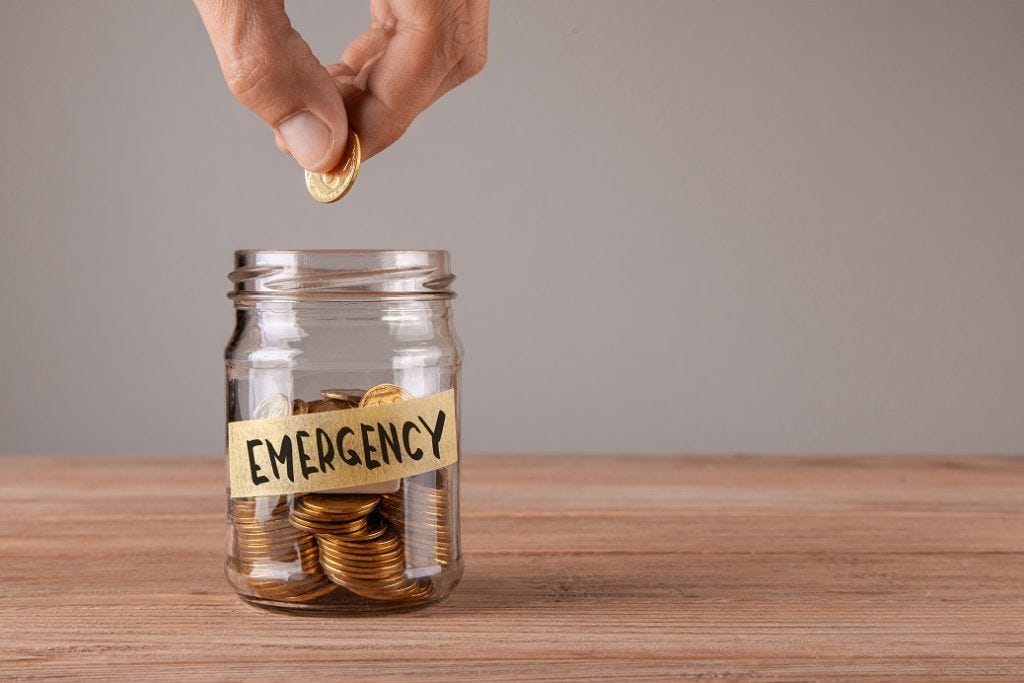
A car repair is not unpredictable just because the date is unknown. Small monthly sinking funds turn irregular costs into ordinary line items.
Every December the same thing happens. Car insurance renews. Christmas shows up. The car's registration is due, and the water heater decides this is the year it quits. None of it is a surprise — and yet it all lands at once, on a credit card, at 24% interest.
Here's the fix, and it's almost insultingly simple: stop treating predictable expenses like emergencies. They aren't emergencies. You knew the car insurance was coming. You know what month it hits. A sinking fund is just a savings account with a name and a job — one fund per expense, fed a little every month, so the big bill never ambushes you again.
This isn't a "budgeting system." It's arithmetic with labels. Let's do it.
What a sinking fund actually is
A sinking fund is money you set aside monthly for a specific, known future expense. Not a mystery "savings goal." A named pile for a known bill.
The math: take the annual cost, divide by 12. That's your monthly deposit. That's the whole technique. The hard part isn't the math — it's remembering to set the thing up before the bill arrives.
Pick your first five funds
Don't overthink this. Start with the expenses that have hurt you the most in the last year. For most people, five funds cover the heavy hitters:
- Car insurance. Typical semi-annual premium: $600–$900. That's $100–$150 a month set aside instead of one $750 bill twice a year.
- Car maintenance. Tires, brakes, the random $400 repair. Budget $100–$150 a month if your car is older than seven years. Your car will need things. This is a fact, not a risk.
- Holiday spending. Say you spend $600 on gifts and travel each December. That's $50 a month from January onward. December-you says thanks.
- Annual subscriptions and memberships. The $150 Prime renewal, the $99 warehouse club, the $120 antivirus nobody should still be paying for. Total them, divide by 12.
- Home repairs. If you own a home, budget 1% of the home's value per year — a $250,000 home means about $208 a month. Renters: a $50–$75 monthly fund covers renter's-insurance deductibles and moving costs.
Say you take home $3,200 a month. Five funds might total $400–$500 a month. That stings until you remember this money was already being spent — it was just being spent in panicked lump sums on credit cards.
Where to keep the money
You don't need five bank accounts. One high-yield savings account works fine, with the tracking done in a spreadsheet, a notebook, or your banking app's notes. Some banks let you create multiple labeled savings buckets for free — if yours does, use them. Labels matter: "$420 — Car Insurance" is money with a purpose. "$420 — savings" is money you'll "borrow" from and never repay.
The rule: sinking fund money is not your emergency fund. Your emergency fund is for actual surprises — job loss, a broken bone. Sinking funds are for bills you can see on the calendar. Mixing them up is how you end up with no emergency fund and a surprise bill anyway.
The math, worked end to end
Let's do one household properly. Imagine these annual known costs:
- Car insurance (semi-annual, $700 twice): $1,400/year → $117/month
- Property tax or renter's costs: $1,200/year → $100/month
- Holiday spending: $800/year → $67/month
- Car maintenance: $1,200/year → $100/month
- Annual subscriptions: $360/year → $30/month
Total: $414 a month. A $4,000 paycheck becomes, mentally, $3,586 — because $414 already has a job. That's not a loss. That's honesty about where the money goes.
Now compare the two Decembers. Without funds: $700 insurance + $800 holidays + $360 subscriptions = $1,860 in one month, straight to the credit card, where at 24% APR it costs real money for months. With funds: you pull $1,860 from the labeled piles and December feels like any other month. Same money. Completely different life.
What counts as a sinking fund expense
The test is simple: Could I see this coming? If yes, it's a sinking fund candidate. Property taxes, registration fees, annual checkups, school supplies, vacation, new tires, the warranty expiring on the dishwasher — all yes.
Not candidates: job loss, medical emergencies, a tree falling on the roof. Those are what the emergency fund is for. If you're funding both, you're covered on both fronts.
How to start this month, not "someday"
- List the bills that blindsided you last year. Pull last year's bank statements if you have to. The top five offenders become your first five funds.
- Divide each by the months left until it's due. If car insurance renews in four months at $700, you need $175 a month for four months — not the $58 you'd get dividing by twelve. New funds get compressed timelines. Next year's cycle runs at the easy rate.
- Set up one automatic transfer. One transfer, the total amount, to savings, the day after payday. You track the split internally. Automation beats willpower every time.
- When a bill hits, pay from the fund and log it. That's the whole lifecycle. Fund builds, bill arrives, fund pays, fund rebuilds.
The two mistakes that kill sinking funds
Mistake one: raiding them. "I'll just borrow from the car fund for concert tickets." No. That's not borrowing. That's canceling the fund. If you want concert tickets, make a sinking fund for concerts.
Mistake two: over-funding tiny things. You don't need a sinking fund for a $30 annual fee — just pay it. Keep funds for expenses of $150+ a year. Fewer buckets, bigger impact, less admin. Five to eight funds is the sweet spot for most households.
Why nobody talks about this
Sinking funds aren't exciting. There's no app to download, no guru to follow, no dramatic transformation story. It's just arithmetic with labels. But it's the difference between the family that "somehow always has money for Christmas" and the family financing it at 24%. The trick isn't magic. It's just knowing the bill is coming and refusing to be surprised by it.